
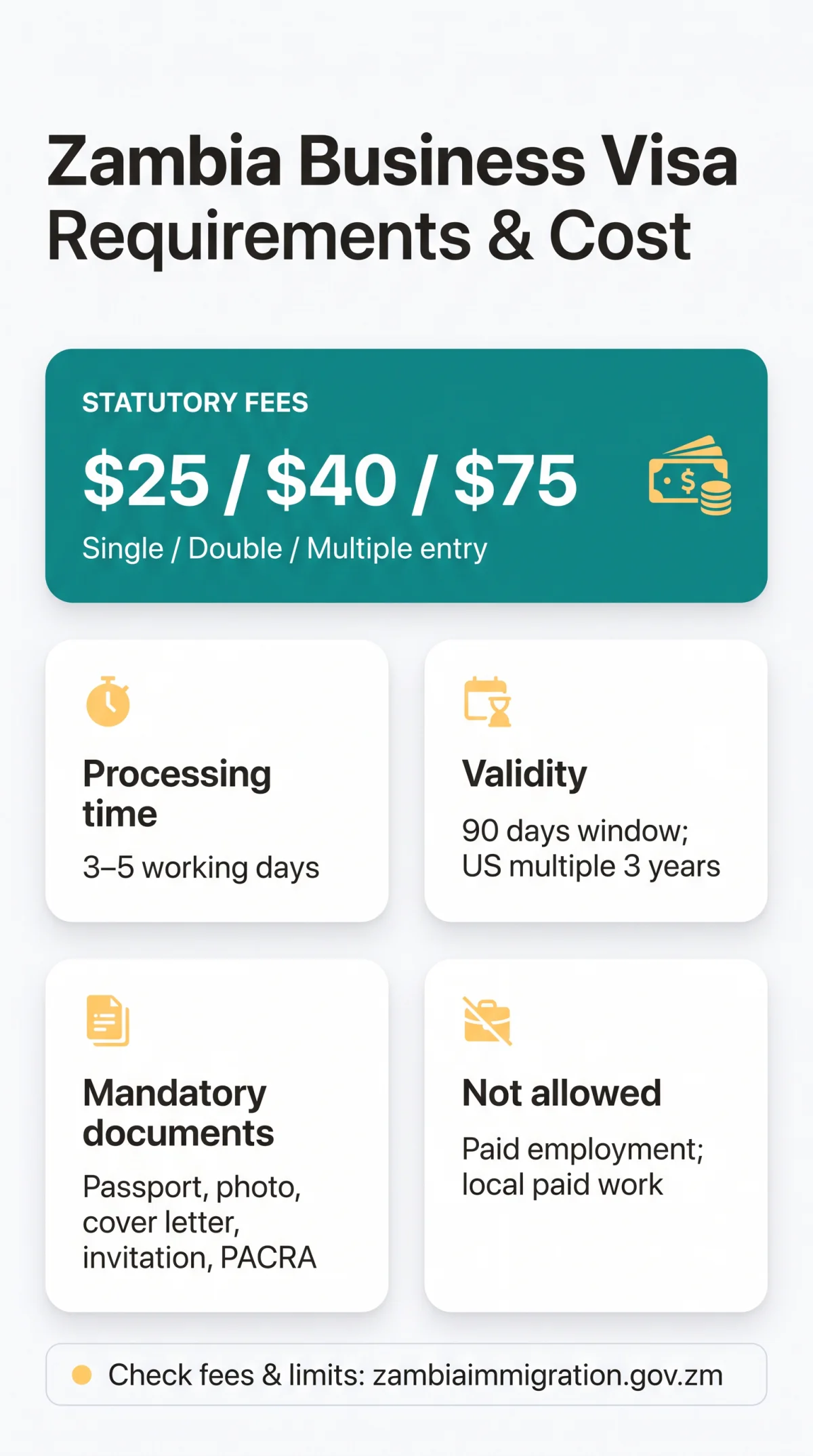
A Zambia business visa costs $25 for single entry, $40 for double entry, and $75 for multiple entry. You’ll need a passport valid for six months, a cover letter on your employer’s letterhead addressed to the Director-General, an invitation from your Zambian host company, and a certified copy of the host’s certificate of incorporation. Approval normally comes within 3 or 5 working days, depending on the visa category. The department’s 2019 guide gives business visitors 30 days in any 12-month period, though its current For Visitors page states 90 days, so confirm the limit before you travel.
This guide walks you through the full Zambia business visa requirements and cost picture, from the invitation pack to the eVisa upload rules. It’s an independent travel-advice article, not a government page – you can verify everything on the official portal at zambiaimmigration.gov.zm. We don’t take fees or file applications for you, so double-check fees and deadlines there before you travel.
What a Zambia Business Visa Covers
As a business visitor, you can attend meetings and conferences, arrange deals, sign contracts, and prospect the market. What you can’t do is take paid employment or any work activity that earns you direct wages in Zambia. Crossing that line has real consequences (see the work permit section below).
- Allowed: meetings and conferences, deal arrangements, contract signing, market prospecting.
- Not allowed: paid employment, any work activity that earns you direct wages in Zambia.
Whether you need a visa at all depends on your nationality. Check the department’s lists of nationals who do not require a visa and of nationals who get one on arrival before booking flights. Even then, travel with your host’s full details and address, a valid return ticket and proof of funds, as these are checked at the port of entry. You will need a formal eVisa for multiple entries.
Zambia Business Visa Cost and Entry Categories
The statutory consular fees are $25, $40, and $75 depending on how many entries you need. Each visa is valid for 90 days from the date of first issuance, with US nationals’ multiple-entry visas running for three years on a reciprocal basis. The validity period is your window to enter, not how long you can stay.
| Visa category | Statutory fee | Entries | Validity window | Permitted stay |
|---|---|---|---|---|
| Single entry | $25 | One | 90 days from first issuance | 30 days per 12 months (see note) |
| Double entry | $40 | Two | 90 days from first issuance | 30 days per 12 months (see note) |
| Multiple entry | $75 | Unlimited within window | 90 days from first issuance | 30 days per 12 months (see note) |
The 2019 permits guide gives business visitors 30 days in any 12-month period, but the current For Visitors page lists 90 days for this category. Confirm the current limit with the Department of Immigration before you plan your trip.
The portal generates an electronic bill, and you pay it online by card before your application is completed.
Government tariff vs agency surcharges
Commercial visa sites charge their own service fee on top of the statutory fee. If you use an agency, ask them to show the government fee separately.
Mandatory Documents and Requirements
Five documents are mandatory for the business category, and the letters inside the bundle follow specific formatting rules:

- Passport copy: at least six months’ validity from your date of entry and at least three full blank pages.
- Passport photo: white background, neutral expression.
- Cover letter from your UK employer, on company letterhead with full address and contact numbers, addressed to the Director-General of Immigration.
- Invitation from your Zambian host company, on company letterhead.
- Certified copy of the host’s Certificate of Incorporation (PACRA).
Officers may ask for supporting evidence such as a return ticket or proof of funds.
The cover letter must be addressed to the Director-General of Immigration; the invitation simply has to come from the host company on its letterhead. The cover letter should include the full address and contact numbers of the employer, and it should be signed. Persons under 16 cannot apply for an e-Visa themselves; if they travel with an adult, they are added to that adult’s application.
The certified certificate of incorporation
The Certificate of Incorporation must come from PACRA (Patents and Companies Registration Agency), and it must be a certified copy. An uncertified scan does not meet the requirement, so ask your host to arrange the certification early.
How to Apply for the Zambia Business eVisa
You apply through the e-Services portal at evisa.zambiaimmigration.gov.zm, and decisions typically come within 3 or 5 working days, depending on the visa category. Here’s the sequence:
- Register your profile on the e-Services portal.
- Select Form 16 (Application for Visa).
- Enter your personal, passport, UK employer, and Zambian host details.
- Upload all documents in jpg, png or tiff format.
- Pay the statutory fee by card or e-Bill.
- Track your status, then download the e-Visa Approval Letter.
Print both the approval letter and the payment receipt before you fly; an immigration officer will ask to see them. Check that your passport details are entered exactly as they appear in the passport and that the cover letter is signed by its author.
Upload specs and fixing errors
Scan documents clearly and save them in one of the accepted formats.
One warning: check the address bar before you pay. Government applications go through zambiaimmigration.gov.zm; other sites are either agencies charging their own service fee on top of the statutory fee, or, in the worst case, operators impersonating the department.
Business Visa vs Work Permit: Legal Distinctions
If you’re doing hands-on work – engineering, IT installation, auditing, technical troubleshooting – a business visa doesn’t cover it. The difference isn’t a technicality. A business visa does not authorise work; for hands-on assignments the department requires a Temporary Employment Permit (TEP).
| Status | Purpose | Duration | Where you apply |
|---|---|---|---|
| Business visa | Meetings, negotiations, site visits | 30 or 90 days per 12 months (confirm with department) | eVisa portal, Zambian missions abroad, or on arrival depending on nationality |
| TEP | Hands-on technical or consulting work | Up to 6 months, one extension possible | Within Zambia, after entering on a business visa |
| Employment Permit | Long-term employment | Over 6 months, renewable up to 10 years | From outside Zambia; you wait abroad until full approval |
The TEP application needs your passport, two photos, your CV, certified qualifications, and your employer’s motivation letter with a job description. The long-term Employment Permit goes further: you must submit a succession plan with a training programme for a Zambian understudy, plus original A5 recruitment ads from two leading Zambian newspapers with the results. The Investor’s Permit requires proof of personal investment of US$250,000 for a new business, or US$150,000 when joining an existing company.
Where the threshold sits in practice
The dividing line is simple: discussing, inspecting and negotiating fall under the business visitor definition, while performing the work yourself, such as installing, auditing or training, requires a Temporary Employment Permit.
Stay Limits, Extensions, and Remote Work
The department’s 2019 permits-and-visas guide states that business visitors are entitled to 30 days in any period of 12 months, while its current For Visitors page gives the figure as 90 days for business visitors and tourists. The 12-month period runs from your first entry into Zambia, not from a calendar date. Confirm the current limit with the Department of Immigration before you plan your trip.
Need longer? If your days were not all granted at the border, you can have them extended at the nearest immigration office, free of charge. If an assignment will clearly exceed 30 days, apply for a Temporary Employment Permit instead.
The department does not publish a rule on working remotely for an overseas employer while in Zambia. What is clear from the business-visitor definition is that paid employment in Zambia and work earning direct wages there are not allowed. If your assignment involves local work, apply for a Temporary Employment Permit.
Common Mistakes That Get Applications Rejected
- Uploading an uncertified Certificate of Incorporation: ask your host to arrange the certified copy before you file.
- Addressing the cover letter to anyone other than the Director-General of Immigration, as the requirement names that office specifically.
- Uploading files in the wrong format: save documents in jpg, png or tiff format before you start.
- Entering passport details that don’t match across the application: ensure every detail matches your passport exactly.
- Paying an intermediary’s service fee when the statutory fee on the government portal is $25.
Frequently Asked Questions (FAQ)
How much does a Zambia business visa cost?
The statutory fees are $25 single entry, $40 double entry, and $75 multiple entry, paid on the e-Services portal. Agencies that file on your behalf add their own service fee on top of these statutory amounts.
What documents do I need for a Zambia business visa application?
Five documents are mandatory: a passport-sized photo, a copy of your passport, a cover letter on your employer’s letterhead with full address and contact numbers addressed to the Director-General of Immigration, an invitation from the host company, and a certified copy of the host company’s certificate of incorporation. Officers may ask for supporting evidence such as a return ticket.
What is the difference between a Zambia business visa and a work permit?
A business visa covers only non-remunerated activities like meetings and site visits. The 2019 permits guide gives 30 days in any 12-month period, while the current For Visitors page lists 90 days, so confirm the limit before you travel. A TEP authorises hands-on technical work for up to 6 months, applied for within Zambia. Long-term employment needs an Employment Permit, filed from abroad.
How long can a business visitor stay in Zambia?
The department’s 2019 permits-and-visas guide states 30 days in any 12-month period, while the current For Visitors page states 90 days for business visitors and tourists. The 12-month window runs from your first entry into Zambia. Confirm the current limit before you travel.
Does the Zambian host company need a PACRA Certificate of Incorporation?
Yes. The business category requires a certified copy of the host company’s certificate of incorporation, uploaded with the rest of the application in jpg, png or tiff format. An uncertified scan does not meet the requirement, so ask your host to arrange the certification before you file.
How long does Zambia business visa processing take?
The department works to 3 or 5 working days from submission, depending on the visa category, provided the application is complete. You can follow progress in the portal’s Submitted folder and download the approval or rejection letter from your account once a decision is made.
Can I work remotely from Zambia on a business visa?
The department does not publish a rule on working remotely for an overseas employer while in Zambia. What is clear from the business-visitor definition is that paid employment in Zambia and work earning direct wages there are not allowed. If your assignment involves local work, apply for a Temporary Employment Permit.
Where do I apply for a Zambia business visa from the UK?
Apply online through the e-Services portal at evisa.zambiaimmigration.gov.zm using Form 16. For non-standard queries the department lists its contact centre and the [email protected] mailbox on its website.
Sources and Further Reading
- Visa Requirements by Purpose of Visit – the official document list for the business category, including the certificate of incorporation rule.
- Guide on Immigration Permits & Visas – the full statutory guide covering TEPs, Employment Permits, and the 30-day business visitor cap.
- Zambia Department of Immigration – For Visitors – current fees, validity rules, and the eVisa application links.
Rules and fees can change, so check the official portal before you travel.