
If you fly to Zambia from the UK without a stop in a country with risk of yellow fever transmission, you don’t need a yellow fever certificate. Zambia yellow fever certificate requirements apply only to travellers aged 12 months or older arriving from, or transiting over 12 hours through, a country with yellow fever transmission risk. Malaria tablets and evacuation insurance matter for every safari region, though.
This guide is an independent, informational resource, not a government site; for authoritative detail, check gov.uk travel advice, the WHO and the CDC. Rules can change, so confirm details before you fly.
Zambia Yellow Fever Certificate Requirements: Who Needs One?
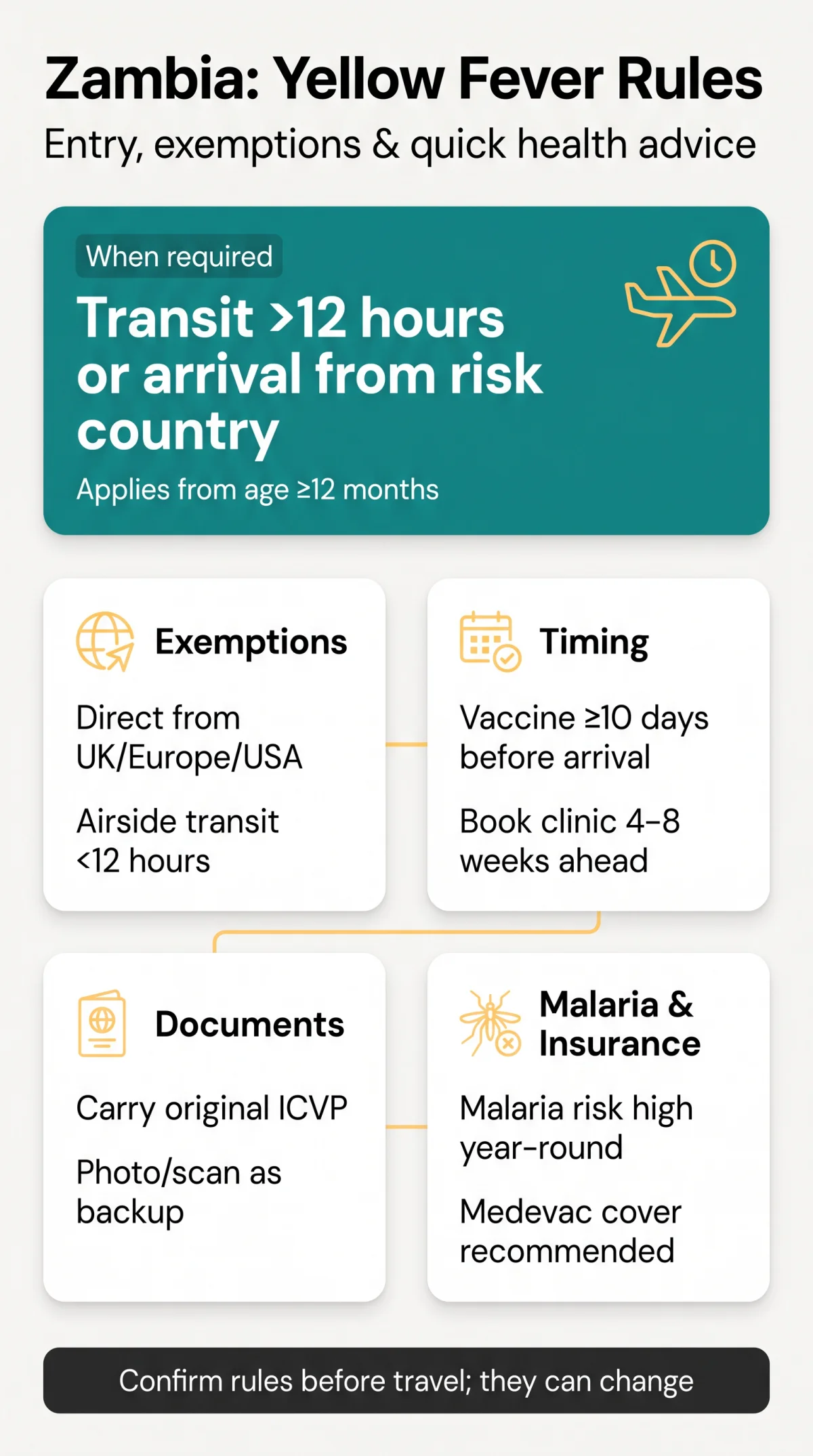
Only two things trigger the certificate rule: your age and where you’ve been. Zambia requires proof of vaccination from travellers aged 1 year and older who arrive from, or transit more than 12 hours through, countries with risk of yellow fever transmission.
Arriving from the UK, Europe or the USA, and not recently in a country with risk of yellow fever transmission? You’re exempt.
Inside Zambia, the potential for exposure to yellow fever is low and limited to North-Western and Western provinces. There is no risk of transmission in the rest of the country, including Lusaka and Livingstone, so the jab is generally not recommended for Zambia travel alone, though it can be considered for a small subset of travellers to North-Western and Western provinces with prolonged travel or heavy mosquito exposure.
Arriving from a risk country with no certificate? You can be refused entry, vaccinated at your own expense, or placed under quarantine or health surveillance.
The 12-Hour Transit Rule: Addis Ababa and Nairobi
Layovers are where UK travellers get confused: if you stay airside for under 12 hours, you don’t need the jab.
| Airline route | Transit hub | Certificate needed? |
|---|---|---|
| Route with no stop in a risk country | None | No |
| Ethiopian Airlines via Addis Ababa | Bole International (ADD) | No, if the airside transit is under 12 hours |
| Kenya Airways via Nairobi | Jomo Kenyatta (NBO) | No, if you stay airside for under 12 hours |
Here’s the trap. A layover of more than 12 hours in Ethiopia or Kenya triggers the requirement, and so does arriving in Zambia from either country, because both are countries with risk of yellow fever transmission.
If that happens, you will need to show the certificate on arrival in Zambia.
Day trips across the Victoria Falls bridge to Zimbabwe? Neither country is a yellow fever risk zone, so no certificate is triggered in either direction.
Certificate Validity, the 10-Day Rule and Document Format
Your yellow card is valid for life. The World Health Assembly adopted an updated Annex 7 to the International Health Regulations (Resolution WHA67.13), in force since 11 July 2016, so Zambia cannot demand boosters or reject older certificates.

Two timing rules matter, though:
- Get the jab at least 10 days before arrival.
- Book your clinic 4 to 8 weeks ahead; the vaccine is available only at registered yellow fever vaccination centres.
Carry the original International Certificate of Vaccination or Prophylaxis (ICVP) issued by your vaccination centre, and keep a photo or scan as a backup.
Infants under 12 months are exempt. People aged 60 and over should not be given the vaccine for travel to Zambia, because of a higher risk of life-threatening side effects. If you will arrive from, or transit more than 12 hours through, a country with risk of transmission, discuss vaccination or a medical letter of exemption with a registered yellow fever vaccination centre or your GP. Grounds include severe allergy to egg or gelatin, severe immunosuppression, thymus disorders, infancy and age 60 and over. An exemption does not guarantee entry, and you may be asked to report symptoms and be placed under surveillance.
Other Vaccines, Malaria and Insurance
Carry your yellow fever certificate and your insurance details with you, as the certificate may be requested on arrival.
Vaccines beyond yellow fever
Book a travel clinic 4 to 8 weeks before departure. Hepatitis A, typhoid, a tetanus booster (if your last dose was over 10 years ago) and up-to-date MMR and polio/diphtheria cover are recommended for all UK travellers. Hepatitis B, rabies and cholera depend on your itinerary; rabies is worth considering for remote bush camps. If you have the yellow fever jab and need MMR, leave at least 28 days between them unless they’re given the same day.
Malaria
Risk is high year-round across all of Zambia, including Lusaka and Livingstone, with Plasmodium falciparum the dominant parasite. Chloroquine doesn’t work there, so your GP or clinic will discuss the options with you:
- Atovaquone-proguanil (Malarone)
- Doxycycline
- Mefloquine
- Tafenoquine
Tablets aren’t a legal entry requirement, but skipping them isn’t sensible. Pair them with a repellent containing at least 20% DEET, and 50% DEET for safari and rural areas, long sleeves treated with permethrin, and sleeping under sealed nets. Avoid swimming, bathing and paddling in fresh water lakes, rivers and streams because of schistosomiasis (bilharzia). In Copperbelt Province, avoid bathing near the Chambishi Stream and where the Mwambashi and Kafue rivers meet, and do not drink untreated local water or eat local fish from that area after the February 2025 mine waste release, because boiling does not remove heavy metals.
Insurance with Medevac cover
Medical facilities throughout Zambia are of a lower standard than in the UK; rural facilities are basic and emergency services are limited. Your policy needs to cover private medical treatment, accessible emergency funds and emergency medical evacuation or repatriation.
Common Mistakes to Avoid
- Assuming an Addis or Nairobi stop means automatic vaccination. Airside under 12 hours is exempt.
- Relying on a copy alone. Carry the original ICVP booklet and back it up with a photo or scan.
- Getting the jab too late. Book 4 to 8 weeks ahead so the 10-day validity window passes before you land.
- Buying insurance without emergency medical evacuation cover.
Frequently Asked Questions (FAQ)
Do I need a yellow fever certificate to enter Zambia from the UK?
No. Direct arrivals from the UK are exempt. The certificate is only mandatory if you arrive from, or transit over 12 hours through, a risk country.
What happens if my flight has a layover in Kenya or Ethiopia?
Nothing, if your airside transit lasts under 12 hours. If the layover exceeds 12 hours, or you arrive in Zambia from Kenya or Ethiopia, you will need a valid certificate, because both countries have a risk of yellow fever transmission.
How long does a yellow fever vaccination certificate stay valid for Zambia?
It is valid for the life of the person vaccinated. Since the updated Annex 7 to the International Health Regulations (Resolution WHA67.13) came into force on 11 July 2016, Zambia cannot require a booster or reject a certificate because more than ten years have passed, even if the card shows an expiry date.
Can I show a digital copy of my yellow fever certificate at Zambian border control?
Carry the original International Certificate of Vaccination or Prophylaxis issued by your vaccination centre, because that is the document border officials ask to see. A photo or scan is useful as a backup and for arranging a replacement from the clinic that vaccinated you, but it may not be accepted instead of the original.
Do I have to upload my vaccination card when applying for the Zambia eVisa?
No. The yellow fever certificate is a border health document rather than an application upload, and officials may ask to see it on arrival. For the current list of documents required with your application, check the official Zambian immigration portal.
Are babies and children exempt from Zambia yellow fever certificate requirements?
Yes, infants under 12 months are exempt. The rule applies from age 1 year and older, and only for arrivals from or transit through risk countries.
What should I do if I cannot receive the yellow fever vaccine for medical reasons?
Ask a registered yellow fever vaccination centre or your GP for a medical letter of exemption. It can be issued for severe egg or gelatin allergy, severe immunosuppression, thymus disorders, infancy and age 60 and over. An exemption is not a guarantee of entry, so you may be asked to report any fever and be placed under health surveillance.
Is malaria medication legally required to enter Zambia?
No, but it’s strongly recommended, because transmission risk is high year-round across the whole country, including cities and safari parks.
Sources and Further Reading
- gov.uk: Health travel advice for Zambia – insurance, malaria and local healthcare guidance.
- CDC: Zambia traveller view – vaccine recommendations and yellow fever entry rules.
- WHO: yellow fever vaccination requirements country list – the list of risk countries behind the entry rule.
- CDC: countries at risk for yellow fever in Africa – transmission zones including Ethiopia and Kenya.
Regulations can change, so check gov.uk and the WHO list before you travel.