
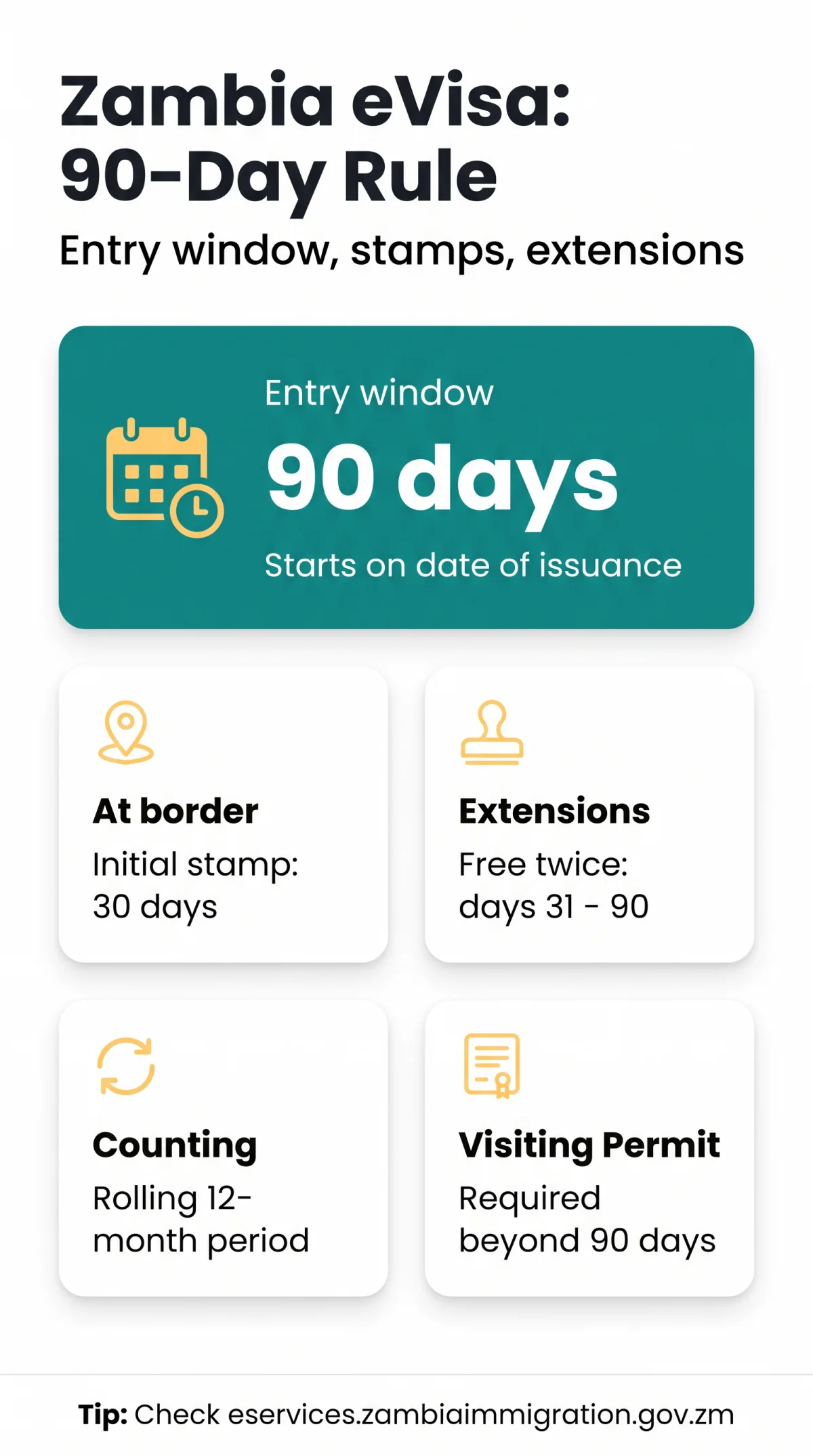
A Zambia eVisa is valid for entry for 90 days from its date of first issuance, according to the Department of Immigration. That window tells you when you can arrive, not how long you can stay. Border officers typically stamp tourists in for 30 days, and you extend free of charge at a local immigration office up to a cumulative 90 days per rolling 12-month period. Remaining in Zambia after your permitted stay expires is a breach of immigration rules, and the sanctions are set by the Department of Immigration.
This guide explains the Zambia eVisa validity period and 90 day rule in plain terms, then walks you through extending at the immigration office in Lusaka. We’re an independent travel information site, not a government agency: we don’t take fees or file applications on your behalf, so confirm current rules at zambiaimmigration.gov.zm before you travel.
Understanding the Zambia eVisa Validity Period and 90 Day Rule
The 90 days on your eVisa approval letter is an entry window, not a stay allowance. It starts on the date of first issuance, the day the Department of Immigration approves your application, not the day you apply or the day you plan to fly.
This applies to Single, Double, and Multiple Entry eVisas alike. US citizens are the one exception: they can get a 3-year multiple entry eVisa on a reciprocal basis, covered later in this guide.
Validity Window vs Permitted Length of Stay
Don’t assume a 90-day eVisa means 90 uninterrupted days in Zambia. Your actual stay is set by the entry endorsement the officer writes in your passport at the border, and by the 90-day ceiling per rolling 12-month period.
When Does Your Validity Actually Start?
Check the approval letter for the issuance date. That’s day one of your 90-day entry window. If you apply months ahead of a safari trip, the clock is already running, so time your application around your flights.
How the 90-Day Stay Limit Works: The 30-Day Stamp
When you land at Kenneth Kaunda International Airport (KKIA) or cross at Livingstone, the officer will usually stamp you in for 30 days, not the full 90 your approval letter mentions. To use your whole allowance, you extend twice at an immigration office, each time free of charge.
The full sequence looks like this:
- eVisa issued: your 90-day entry window starts.
- Border: officer stamps an initial 30-day stay.
- First extension: adds days 31 – 60, free of charge.
- Second extension: adds days 61 – 90, free of charge.
- Day 90: exit Zambia or apply for a Visiting Permit.
Your 90-day ceiling is counted over a rolling 12-month period from your date of first entry, not a calendar year. Zambia is not the Schengen area, and the two rules get mixed up constantly:
| Rule | Stay limit | Counting period |
|---|---|---|
| Zambia (90/365) | 90 days total | Rolling 12 months from first entry |
| Schengen (90/180) | 90 days total | Rolling 180 days |
If you’re used to the Schengen short-stay calculator, leave that habit in Europe. Zambia counts backwards 12 months, and each extension consumes part of that balance.
Inspecting Your Arrival Stamp at the Port of Entry
Before you step away from the immigration booth, read the date written on your entry stamp. That date overrides your eVisa approval letter. If the number of days falls short of what your trip needs, extend your stay at an immigration office before the entry expires.
Business Visitors vs Tourists
Visa-exempt nationals visiting for business had their limit extended from 30 to 90 days within a rolling 12-month period, a change announced in February 2026, though older government materials still cite 30 days. Tourist limits are unchanged.
Passport and Entry Requirements at the Border
Your passport must be valid for at least six months from your date of entry into Zambia. The requirement for 3 full blank pages is written into the visa-on-arrival rules, while UK travel advisories mention 2 pages, so it’s safer to have 3.
Here’s what to have ready for the officer:
- Passport valid 6 months beyond entry, with 3 blank pages.
- Return or onward air ticket.
- Proof of accommodation, such as a hotel booking or host invitation.
- Proof of sufficient funds for your stay in and departure from Zambia.
- Yellow Fever certificate, only if arriving from a risk country.
UK citizens don’t need an eVisa at all; as visa-exempt nationals, you enter on your passport. The 90-day limit, the 30-day stamp, and the free extensions apply to you in exactly the same way. Children under 16 can’t apply for an eVisa independently; they must be included in an accompanying adult’s application.
How to Extend Your Visa at the Immigration Office in Lusaka
Tourist extensions within the 90-day cap are free of charge at the Immigration Headquarters in Lusaka or at your nearest Department of Immigration office. You must file before your current stamp expires, so don’t leave it to the final week.
Here’s the process:
- Present your documents to the immigration officer.
- Collect your passport and check the new entry endorsement.
- Verify the new expiry date before leaving the counter.
Bring these documents:
- Your passport with the current entry stamp.
- A printout of your eVisa approval letter.
The Department doesn’t publish a full checklist of extension requirements, so confirm any additional documents at the office.
The extension itself is free of charge at the Department of Immigration. An intermediary may charge a fee for help with a procedure that costs nothing in itself; the fraud to watch for is a site posing as a government office.
Staying Beyond 90 Days: The Visiting Permit
If you want more than 90 days, the free extension route ends and a formal Visiting Permit begins. This is a separate application filed with the Department of Immigration, and a statutory fee is charged for the permit, so confirm the current amount at the immigration office. Business visitors switch to a Temporary Employment Permit instead.
| Option | Stay covered | Cost |
|---|---|---|
| Tourist extension | Up to 90 days total | Free of charge |
| Visiting Permit | Beyond 90 days | Statutory fees apply |
What Happens If You Exceed Your Permitted Stay
Overstaying is a breach of immigration rules, not a paperwork slip. The level of sanctions isn’t published, so confirm current amounts with the Department of Immigration.
The right step depends on your situation:
| Situation | What to do |
|---|---|
| Your stamp is close to expiring | Extend at the nearest immigration office before your permitted stay runs out |
| Your stamp has already expired | Go to the nearest Department of Immigration office to regularise your stay |
| Overstay found at the point of exit | The immigration authorities determine the sanction; no fixed amounts are published |
| Planning to stay beyond 90 days | Apply for a Visiting Permit before your permitted stay ends |
If your stamp has already expired, report to the nearest immigration office. When you do fly out, the $25 USD international departure tax and security charges are usually included in your ticket price, but if they’re not, you’ll have to pay them in cash in Zambian kwacha.
Visa Types, Statutory Fees and Avoiding Scams
Statutory visa fees are modest: $25 USD Single Entry, $40 USD Double Entry, and $75 USD Multiple Entry. Higher amounts on private websites are an intermediary’s markup, not a statutory fee.
| Visa type | Entry window | Max stay | Statutory fee |
|---|---|---|---|
| Single Entry eVisa | 90 days from issuance | 90 days via extensions | $25 USD |
| Double Entry eVisa | 90 days from issuance | 90 days via extensions | $40 USD |
| Multiple Entry eVisa | 90 days from issuance (3 years for US citizens) | 90 days via extensions | $75 USD |
| KAZA UNIVISA | 30 days | Up to 30 days | $50 USD |
The KAZA UNIVISA covers multiple entries between Zambia and Zimbabwe plus day trips into Botswana via Kazungula, and it’s valid for up to 30 days, so pick the national eVisa for longer stays in Zambia. US citizens can get a 3-year multiple entry eVisa on a reciprocal basis, though each stay still follows the standard limits and extension procedures.
Check any visa site’s domain before paying: Zambian government pages end in .gov.zm, and you can track your application status on the e-services portal at eservices.zambiaimmigration.gov.zm.
Common Mistakes to Avoid
- Assuming the 90-day eVisa means 90 automatic days. You’ll get a 30-day stamp and must extend twice, free of charge.
- Walking away without reading the entry stamp. The date on the stamp overrides your approval letter, so check it at the booth.
- Counting the 90 days per calendar year. Zambia uses a rolling 12-month period from your first entry.
- Paying for a tourist extension. Within the 90-day ceiling it’s free of charge at the Department of Immigration, though an intermediary may charge for handling the paperwork.
- Applying for the eVisa too early. The 90-day window starts at approval, so a six-months-early application can expire before you fly.
Frequently Asked Questions (FAQ)
How long is a Zambia eVisa valid for UK tourists before travel?
Standard tourist eVisas are valid for 90 days from first issuance, and you must enter within that window. UK citizens don’t need an eVisa at all, though the same stay limits apply on visa-free entry.
Does the Zambia eVisa validity period and 90 day rule mean I can stay 90 days continuously?
No. Border officers typically stamp an initial 30-day stay. To use the full 90 days, you extend twice at a local immigration office before each 30-day period runs out, both free of charge.
Where is the immigration office in Lusaka for visa extensions?
You can extend at the Immigration Headquarters in Lusaka or at the closest immigration office to where you are in Zambia. Apply before your current stamp runs out.
How much does it cost to extend a tourist visa in Lusaka?
Nothing. Extensions for ordinary visitors within the 90-day ceiling are free of charge. Fees only apply if you request a Visiting Permit to stay beyond 90 days.
How is the 90-day stay rule calculated in Zambia?
Zambia counts your cumulative stay over a rolling 12-month period from your date of first entry. It’s not a calendar year, and it’s not the Schengen 90/180 rule. Each extension eats into the same 90-day balance.
What are the penalties for overstaying an eVisa in Zambia?
Overstaying is a breach of immigration rules, and the sanctions are set by the Department of Immigration. The amounts aren’t published, so confirm them at an immigration office, and go to the nearest office if your stamp has already expired.
Can I use the KAZA UNIVISA to stay in Zambia for 90 days?
No. The KAZA UNIVISA is valid for up to 30 days covering Zambia and Zimbabwe, plus day trips to Botswana via Kazungula. For a longer stay in Zambia, choose the national eVisa instead.
What should I do if the border officer stamps my passport for fewer days than my trip?
Check the stamp before leaving the booth, because that date controls your stay. If the days fall short of your trip, extend at a Department of Immigration office before the stamp expires, free of charge within the 90-day ceiling. Details are on zambiaimmigration.gov.zm.
Sources and Further Reading
- Zambia Department of Immigration: For Visitors – eVisa validity, stay limits, extensions and fees.
- UK travel advice: Zambia entry requirements – passport rules and stay limits for UK citizens.
- Ministry of Home Affairs: Department of Immigration – permits and immigration procedures.
- Visa Requirements by Purpose of Visit – tourist and business visa categories.
- Fragomen: Zambia – Extended Duration of Stay for Visa-Exempt Nationals Entering for Business Purposes (25 February 2026) – stay limit change for business visitors.
- EU short-stay calculator – for contrast with the Schengen 90/180 rule.
Immigration rules can change, so confirm current requirements on the Department of Immigration’s portal before you travel.