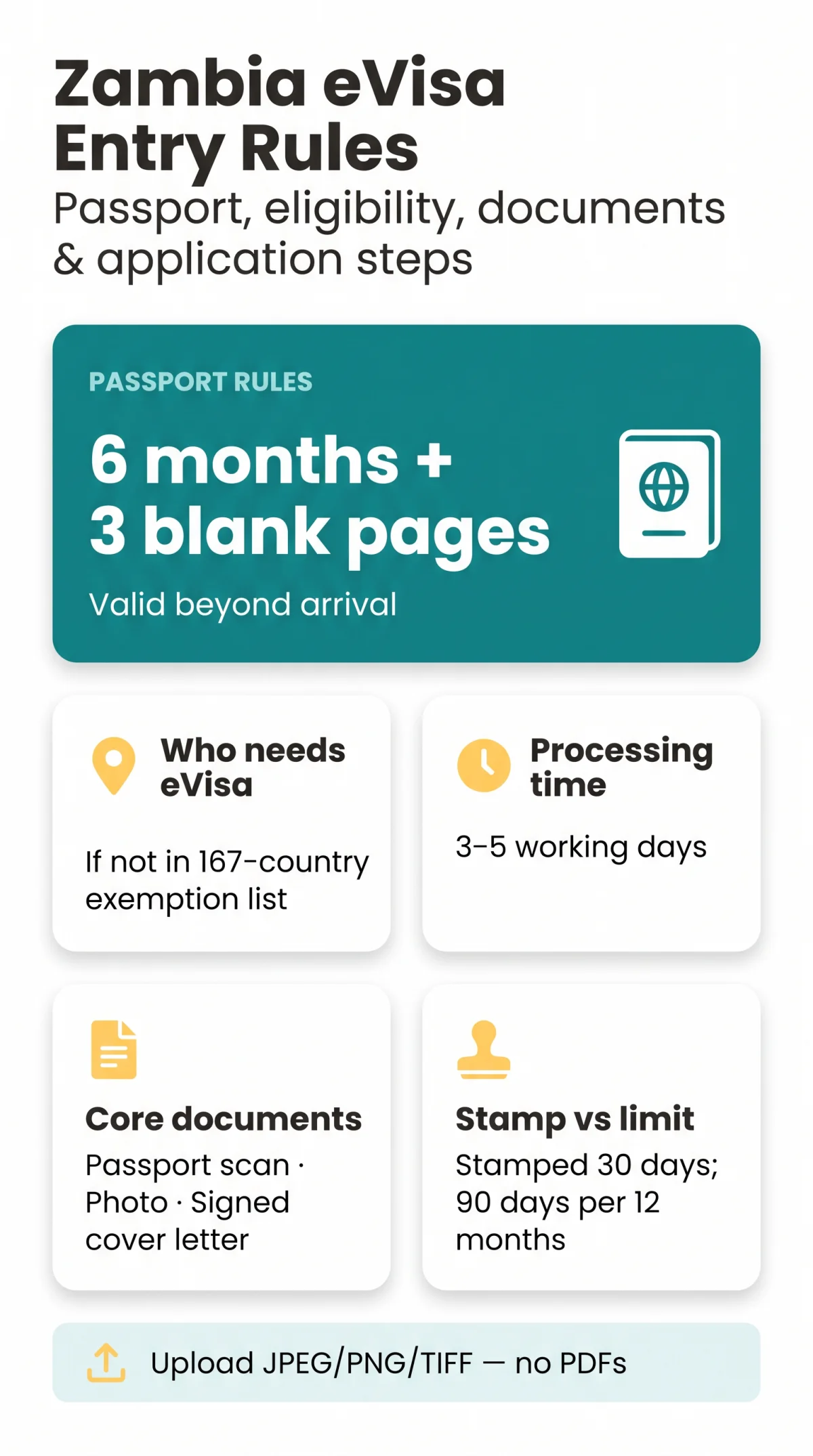
UK tourists can enter Zambia visa-free for up to 90 days a year, but the passport must be valid for six months beyond arrival with three blank pages. Nationalities that are not visa-exempt need an eVisa, issued in three to five working days; visa-exempt business visitors may stay up to 30 days in any 12-month period. Air arrivals must show a valid return or onward ticket; those arriving by land or water must show enough funds for their stay in and departure from Zambia.
This guide walks you through the Zambia eVisa entry requirements step by step: who needs a visa, what documents to gather, and how to apply on the government portal. We’re an independent travel information site, not a government agency – we don’t take fees or submit applications on your behalf. You’ll find the official portal at eservices.zambiaimmigration.gov.zm, and it’s worth checking your details there before you fly.
Who Needs a Zambia eVisa?
If you hold a UK passport and you’re travelling for tourism, you don’t need a visa at all. Zambia exempts citizens of 167 countries and territories – including the UK, EU states, the USA, Canada, Australia and Japan – from visas; the list reached 167 countries and territories after Zambia waived visa requirements for a further 53 nationalities with effect from 1 January 2025. You can read the exemption list on the Department of Immigration website.
Not everyone is off the hook, though. You must apply for an eVisa if your nationality isn’t on the exemption list. Visa-exempt visitors are limited to 90 days a year as ordinary visitors and 30 days as business visitors. And remember: visa exemption doesn’t skip the border checks – you still need a valid passport, a return ticket and, for land arrivals, proof of funds.
| Nationality and purpose | Visa category | Maximum stay | Key document |
|---|---|---|---|
| UK, EU, USA, Canada, Australia, Japan – tourism | No visa needed | 90 days per rolling 12 months | Passport and return ticket |
| Nationalities not on the exemption list – business visit | Business eVisa | 30 days per 12 months | Host company invitation letter |
| Visiting family or friends | Ordinary / Visitor eVisa | 90 days per 12 months, stamped in stages | Host’s NRC or permit copy |
| Passing through overland | Transit eVisa | 7 days | Signed cover letter to the Director General of Immigration |
When British Citizens Still Need an eVisa
The line between tourism and business matters here. A Business Visitor is capped at 30 days in any 12-month period, and extending that requires a Temporary Employment Permit rather than a tourist extension. If you’re attending meetings or exploring a partnership, apply for a Business eVisa – the application needs a cover letter on company letterhead, an invitation letter from your Zambian host, and a certified copy of the host company’s Certificate of Incorporation.
For an Ordinary or Visitor eVisa, your host in Zambia does part of the paperwork. They provide a signed cover letter with their full physical address and phone number, plus a copy of their National Registration Card (NRC) or valid Zambian immigration permit, front and back. You add your passport scan, photo and confirmed return air ticket.
Six-Month Passport Validity and Three Blank Pages
Your passport has to stay valid for at least six months beyond the date you enter Zambia. That’s a hard rule, and it’s enforced at check-in, not just at the border. Check with your travel provider before departure that your passport meets this requirement, and renew it if it falls short.
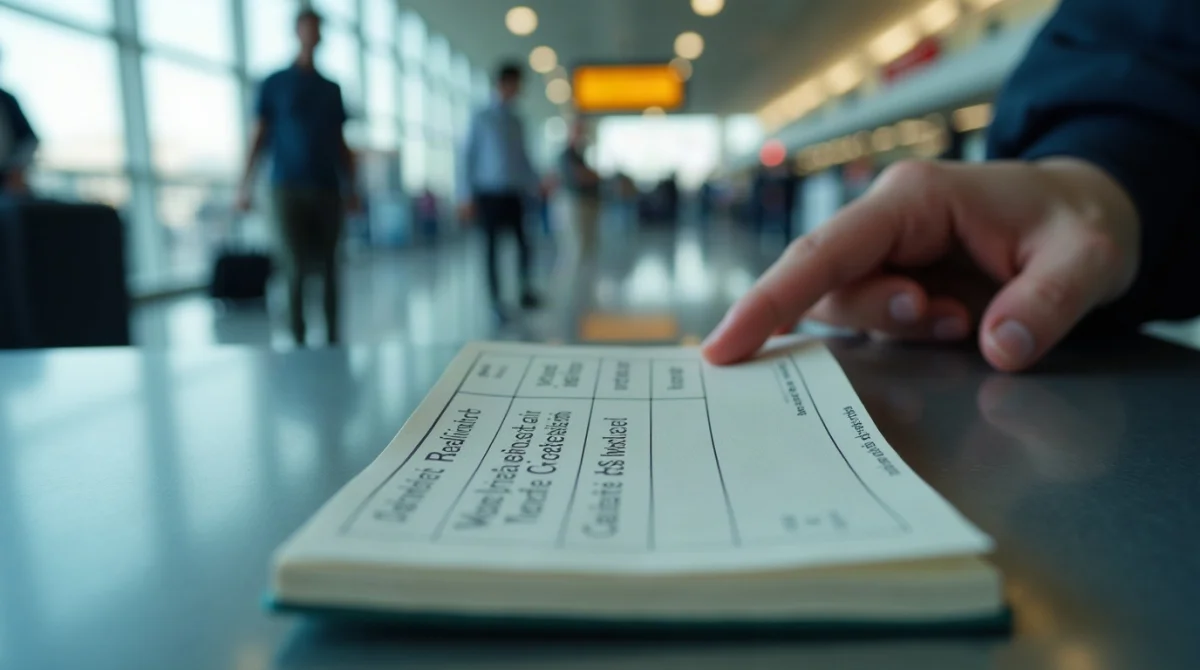
The blank pages rule catches even more people. Zambia’s Department of Immigration asks for at least three full blank pages.
One conflict worth knowing: the UK’s FCDO travel advice mentions two blank pages, but the Department of Immigration asks for three full blank pages, so plan on three and renew your passport if you have fewer.
Return Tickets and Proof of Sufficient Funds
Flying in? You need a confirmed return or onward air ticket, with the departure date inside your permitted stay. Immigration officers check it on arrival, and your travel provider may ask to see it before departure.
Crossing by land or river – at Kazungula Border Control or the Victoria Falls border – changes the picture. There’s no return flight to show, so immigration officers ask for proof of sufficient funds instead. Immigration asks for evidence that you can cover your stay in and departure from Zambia; no minimum amount is published.
If you plan to pay anything in cash US dollars, bring “large head” US dollar notes; the old small-head series is no longer accepted in Zambia.
Proof of Funds for Overland Arrivals
Arriving overland, you won’t be asked for a flight ticket, but you must show enough funds for your stay in and departure from Zambia.
Documents and Upload Specs for Your Application
Every eVisa application, whatever the type, needs the same three core items: a scan of your passport’s bio-data page, a recent passport-sized photo, and a signed cover letter addressed to the Director General of Immigration. The letter should state your purpose, full name and passport number, travel dates, intended length of stay and who is paying for the trip.
On top of that, the extras depend on why you’re going:
- Tourist eVisa: confirmed return or onward air ticket, plus a hotel or lodge reservation
- Business eVisa: cover letter on company letterhead, host invitation letter, certified Certificate of Incorporation copy
- Ordinary / Visitor eVisa: host’s cover letter, NRC or permit copy, confirmed return ticket
File Formats and Portal Technical Pitfalls
All uploaded documents must be in JPEG, TIFF or PNG format – PDFs aren’t accepted. Scan at a resolution where every character on the bio-data page is readable. Before you reach the payment step, allow pop-ups for the site; with pop-ups blocked the payment can stick at “the request has been sent to the bank”.
Applying for a Zambia eVisa Step by Step
The whole application happens online at eservices.zambiaimmigration.gov.zm, the Department of Immigration’s eServices portal. The steps are:
- Register a user account on the portal and complete the registration form
- Select your visa type and number of entries – single, double or multiple
- Enter your personal data, matching the MRZ line on your passport exactly
- Upload your documents in JPEG, PNG or TIFF format
- Pay online by credit or debit card and save the payment receipt
- Print your approval letter and payment receipt to show the immigration officer on arrival
And double-check that the port of entry you name matches your booking.
Common Rejection Mistakes and How to Avoid Them
Copy your passport details exactly from the bio-data page, name the port of entry that matches your booking, and keep your travel dates consistent with your ticket and accommodation booking.
Tracking Your Application After Submission
Once you submit the application it moves from Drafts to the Submitted folder and can no longer be edited online. If a reviewer spots an error, you’ll get a response to address, or you may need to reapply. Applications sit in a “Drafts” folder until submitted, so you can edit freely before payment. If you hear nothing within the expected timeframe, contact the Department of Immigration with your case number.
Fees, Processing Times and Validity Windows
Government fees run from $25 single entry to $75 multiple entry, with standard approvals issued within three to five working days. Older, higher figures still circulate elsewhere; these are the Department of Immigration’s current fees:
| Visa type | Government fee (USD) | Entry window | Maximum single stay |
|---|---|---|---|
| Single entry | $25 | 90 days from issue | 30-day stamp, extendable |
| Double entry | $40 | 90 days from issue | 30-day stamp, extendable |
| Multiple entry | $75 | 90 days from issue | 30-day stamp, extendable |
| Transit | $25 | 7 days | 7 days, overland only |
Standard processing takes three to five working days, so submit your application well before departure.
Visa Validity vs Length of Stay
This trips up a lot of travellers. The 90-day window is when you can enter Zambia – it’s not how long you can stay. US nationals are the exception, receiving three-year multiple-entry validity under a reciprocal arrangement. Separately, air passengers pay the equivalent of USD 25 for international travel and a USD 3 security charge for domestic travel; it’s usually included in your ticket price, and if not, you pay it in Zambian kwacha cash at the airport.
The 30-Day Stamp and the 90-Day Limit
Here’s the trap most guides miss: even though tourists can stay 90 days a year, the 90 days are not granted all at once – arrivals are usually stamped for 30 days, and the stamp in your passport governs your legal stay.
If you want to stay longer than the days stamped in your passport, call at the nearest immigration office before they expire and ask for a free extension.
The 12-month period runs from your first entry into Zambia, not from 1 January.
Overstay Penalties
Overstaying can result in fines, detention or deportation, so seek an extension before the stamped days expire. Business visitors face a separate, stricter rule: 30 days total per 12 months, with extensions only via a Temporary Employment Permit.
Children, KAZA UNIVISA and Health Clearance
Three special cases deserve their own planning. Children under 16 cannot apply for an eVisa on their own; if they travel with an adult they must be included in that adult’s application. At the border, each child needs a valid passport (six-plus months), an international birth certificate in English, and a notarised consent letter from the parent who is not travelling. Unaccompanied minors need written clearance from the Director General of Immigration, plus the receiving guardian’s contact details in Zambia.
Then there’s the KAZA UNIVISA. At $50, it gives you 30 days of unlimited cross-border travel between Zambia and Zimbabwe, plus day trips into Botswana via Kazungula. You can apply online or get it at Kenneth Kaunda International Airport, Harry Mwaanga Nkumbula International Airport, the Victoria Falls border and Kazungula.
Health rules are simple: a yellow fever vaccination certificate is required only if you’re arriving from, or transiting more than 12 hours through, a WHO-designated risk country. The rule applies to travellers aged one and over, and the vaccination must be given at least 10 days before arrival, so check your routing against the risk-country list if you connect elsewhere. There are no COVID-19 entry requirements.
When the KAZA UNIVISA Beats a Standard eVisa
Landing in Livingstone and planning to see both sides of Victoria Falls? If you need visas for both countries, the $50 UNIVISA covers 30 days of travel between Zambia and Zimbabwe; British passport holders already enter Zambia visa-free. One limitation: it becomes invalid if you overnight in Botswana, so it suits day trips only on that side.
Common Mistakes That Derail Zambia Trips
- Arriving with two blank pages. UK FCDO advice mentions two, but the Department of Immigration asks for three full blank pages, so plan on three.
- Assuming the 90-day allowance means a 90-day stamp. You get 30 days at the border. Visit an immigration office before it expires for a free extension.
- Uploading PDFs. All uploaded documents must be in JPEG, TIFF or PNG format. Convert your files first.
- Paying with old US dollar bills. Only “large head” notes are accepted; the small-head series is not.
- Paying an agency by accident. Commercial sites charge a service fee on top of the government fee, while sites impersonating the Department of Immigration are a scam – apply directly at eservices.zambiaimmigration.gov.zm.
Frequently Asked Questions (FAQ)
Do UK citizens need a visa to enter Zambia as tourists?
No. British tourists stay visa-free for up to 90 days within a rolling 12-month period. You still need a passport valid six months beyond arrival with three blank pages, a return ticket, and proof of funds if you arrive by land or water. Business visitors from the UK also enter without a visa but may stay only 30 days in any 12-month period; longer business stays need a Temporary Employment Permit.
What are the Zambia eVisa entry requirements for passports?
Your passport must be valid for at least six months beyond your entry date and contain three full blank pages. Check with your travel provider before you fly, because you can be refused entry to Zambia without a valid travel document.
How many blank passport pages does Zambia require?
Three full blank pages. UK FCDO advice mentions two blank pages, but the Department of Immigration asks for three full blank pages, so plan on three.
How much does a Zambia eVisa cost?
Government fees are $25 for single entry, $40 for double entry, $75 for multiple entry, and $25 for a transit visa valid up to 7 days. Commercial agencies charge extra service fees on top, so apply directly through the official portal to pay only the government rate.
Can I get a visa on arrival in Zambia instead of an eVisa?
Nationalities in the visa-on-arrival category can get a single or double entry visa at a port of entry, but must have their host’s details and physical address, and multiple entry visas are issued only through the eVisa facility. The same passport, ticket and funds conditions apply either way.
Why did my entry stamp say 30 days if tourists can stay 90?
Zambia stamps 30 days on arrival regardless of the annual ceiling. Call at the nearest immigration office before the stamped days expire and ask for a free 30-day extension, repeatable up to 90 days in total.
How do I apply for a Zambia eVisa for a child under 16?
Children under 16 cannot apply for an eVisa on their own; if they travel with an adult they must be included in that adult’s application. At the border, carry their international birth certificate in English and a notarised consent letter from any parent who is not travelling.
Where do I apply for a Zambia eVisa online?
Apply at eservices.zambiaimmigration.gov.zm, the Zambia Department of Immigration’s eServices portal. Register an account, complete the form, upload your documents, pay by card, and print your approval letter and payment receipt before departure.
Sources and Further Reading
- FCDO – Zambia entry requirements: UK government guidance on visas, stays and border rules
- Zambia Department of Immigration – For Visitors: official visa categories, fees and document lists
- Zambia eServices portal: where you register and submit your eVisa application
- Nationals who don’t require a visa: the full exemption list
- FCDO – Zambia travel advice: broader safety and health guidance for your trip
Rules can change, so confirm your details on the official portal before you travel.