
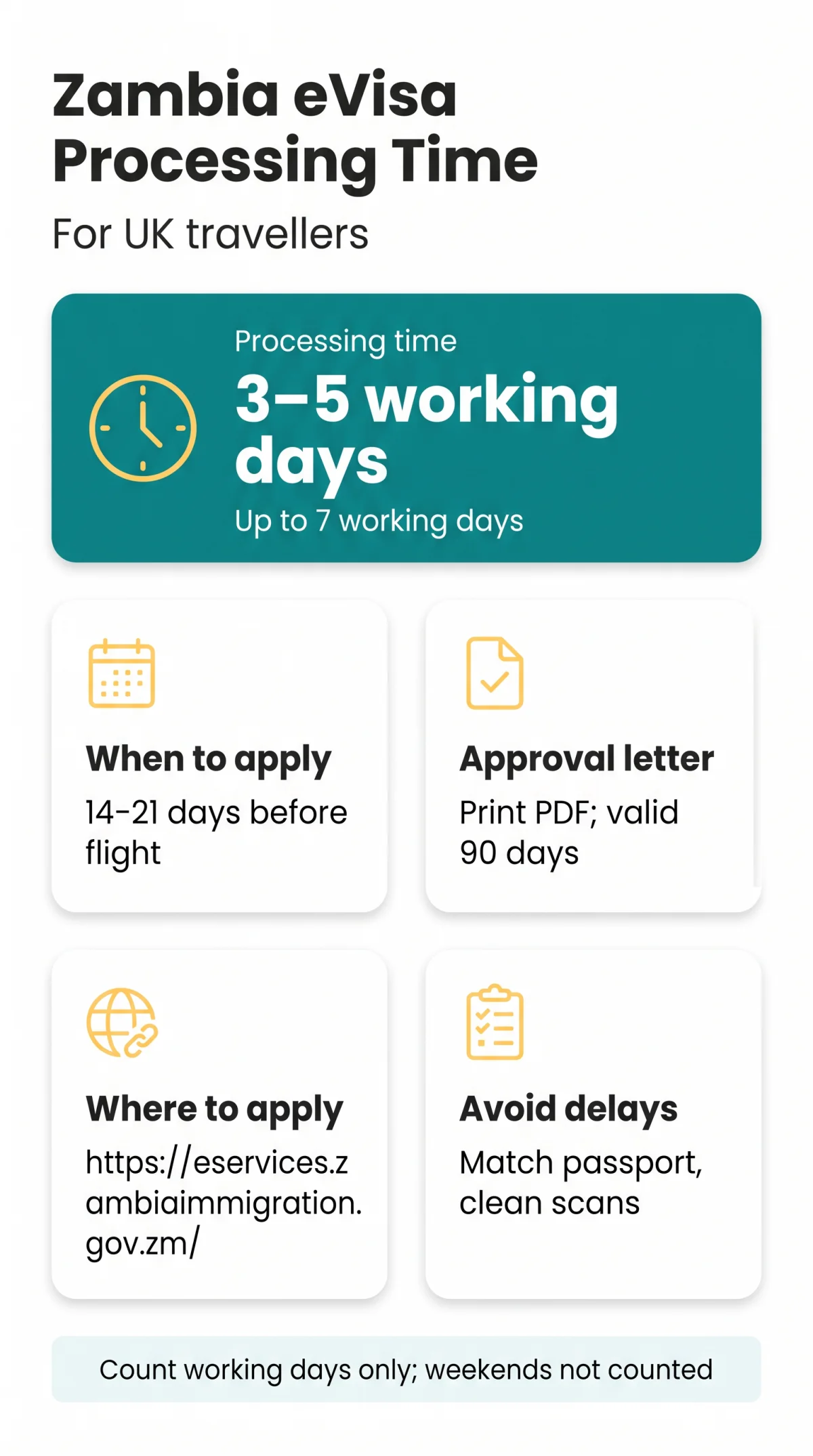
The standard Zambia eVisa processing time is 3 to 5 working days, depending on your visa category, and some applications take up to 7 working days. Processing is counted in working days, not calendar days, so plan your timeline accordingly. Apply 14 to 21 days before you fly.
This guide is written for UK travellers who need to plan around that timeline. It’s an independent, informational guide, not a government site. You apply and pay only through the official Zambia eServices portal. We don’t charge fees or file applications for anyone, so double-check the details on the official portal before you travel.
Do UK Citizens Need an eVisa for Zambia?
Not every traveller needs an eVisa. Before you apply, check which category your passport falls into on the Department of Immigration’s lists of nationals who do not require a visa, who get a visa on arrival, and who must apply before travel.
You do need to apply online when your trip falls outside the exemption, which includes business trips, longer stays and multiple-entry visas, issued only by Immigration Headquarters through the eVisa facility. Work or volunteering needs a separate immigration permit, not an eVisa.
Crossing between Zambia and Zimbabwe? The KAZA UNIVISA lets you use one visa for both countries and is applied for separately. Commercial sites charge a service fee on top of the government fee, so check whether you need a visa at all before you pay for one.
Standard Processing Time: 3 to 5 Working Days
The baseline is 3 to 5 working days, depending on visa category. During busy periods, allow up to 7 working days. Some commercial sites quote 10 to 15 working days as their “standard”; that is their own service timeline, not the government baseline.
What arrives at the end isn’t a sticker but an Approval Letter, sent by email or downloaded from the eServices portal. You print it out and present it, with your payment receipt and passport, to an Immigration Officer at your port of entry.
Note the difference between the portal and the people. The online form accepts submissions 24/7; processing itself is counted in working days.
| Visa type | Official government fee | Standard waiting time (depending on visa category) |
|---|---|---|
| Single-entry tourist eVisa | US $25 | 3 – 5 working days |
| Double-entry tourist eVisa | US $40 | 3 – 5 working days |
| Multiple-entry eVisa | US $75 | 3 – 5 working days |
| Transit eVisa | US $25 | 3 – 5 working days |
| KAZA UNIVISA | US $50 | 3 – 5 working days |
The waiting time shown applies to most applications, but actual processing time may vary by visa category.
Weekends and Public Holidays
Submit on a Friday evening or over the weekend, and your application enters the queue on the next working day. Count working days only, and remember that Zambian public holidays are not working days.
Express and Urgent Options: What You’re Paying For
Private intermediaries sell “Rush”, “Super Rush” and “24-hour” tiers for an extra service fee. What they speed up is their own document pre-checking and data entry before they lodge your application.
Paid express tiers come from private intermediaries, not from the Department of Immigration, and the decision timeline stays with immigration authorities. An express option makes sense mainly if you want a professional to catch errors before submission when your deadline is tight.
When to Submit Before Departure
Submit 14 to 21 calendar days before you fly. That gives you a comfortable buffer over the 3-to-5 working day baseline for document requests, re-uploads or public holidays.
Don’t apply six months ahead, though. The Approval Letter is valid for 90 days from issuance, so an early approval can expire before you travel.
- Ideal window (14 – 21 days): plenty of slack for queries, photo re-uploads and holiday freezes.
- Last-minute window (5 – 7 days): workable, but a single document request can push you past your flight.
- High-risk zone (under 72 hours): no guarantee the approval letter will be issued in time, and you need it to present at the port of entry.
That last point matters if you’re booking non-refundable flights. Get the Approval Letter first, or wait to book until you’re inside the safe window.
How to Apply and Avoid Form Field Errors
Most delays come from avoidable form errors, so it’s worth slowing down at three fields in particular.
- Create a profile on the eServices portal.
- Complete the form, checking the three fields below as you go.
- Upload your documents in JPEG, TIFF or PNG format.
- Pay the fee and click Finish to submit.
- Full Name as in Passport: it must match your passport exactly. A typo or a wrong middle name extends verification.
- Port of Entry: select the port you will actually use; eVisa approval letters are accepted at any Zambian port of entry.
- Address in Zambia: give the full hotel or lodge address, or your host’s details.
Once you click Finish, your application moves to the Submitted folder and gets a reference number. It cannot be edited online after that, so check every field before you submit. Children under 16 can’t apply independently; they must be included in the accompanying adult’s application.
Documents That Prevent Rejection
Incomplete or unclear documents are the usual reason an application is held up, so prepare these before you start.

- Passport scan: clear copy of the bio-data page, with the passport valid at least 6 months from the date of entry.
- Photo: a recent passport-sized photograph of the applicant.
- Covering letter: addressed to the Director General of Immigration and signed by its author.
- Return air ticket: a copy of your return or onward ticket.
- Proof of accommodation: hotel booking or host details covering your full stay.
Business applicants add a letter of invitation from the host company and a certified copy of its Certificate of Incorporation. Transit applicants submit the photo, passport copy and a signed cover letter addressed to the Director General of Immigration; the transit visa covers overland transit for up to 7 days.
What Delays Approval
Delays usually come from the application itself: inaccurate details, missing documents or requests for clarification. Nationality-based processing protocols can also add time for some passports.
| Cause of delay | What happens | How to avoid it |
|---|---|---|
| Inaccurate information needing clarification | Adds time while the missing information is supplied | Match every field to your passport exactly |
| Missing or poor document scans | Adds time while the missing document is supplied | Upload clean JPEG, TIFF or PNG files first time |
| Cover letter not addressed or unsigned | Adds time until the letter is corrected | Address it to the Director General of Immigration and sign it |
| Dates mismatched with flight bookings | Adds time while dates are verified | Check application dates against your itinerary |
| Business host missing registration certificate | Adds time until the certificate is provided | Get the Certificate of Incorporation before applying |
If additional documents or clarification are requested, the application waits until you supply them, which is why one unclear scan can cost you days.
Health Checks at the Border
A Yellow Fever certificate is an entry requirement, not part of the eVisa form. It is required for travellers aged one year and over who arrive from, or spend more than 12 hours in transit through, a yellow fever risk country, and the vaccination must be given at least 10 days before entry.
Checking Status and Escalating Stalls
Here’s how to track your file, and what to do if it stalls.
- Log in to your eServices user account and open My Workplace, where applications sit in folders by status.
- Check the folder your case sits in: Draft, Submitted, Approved or Rejected.
- Open the Outgoing Documents tab in your account before assuming anything is wrong.
The approval or rejection letter can be viewed, printed or downloaded from the Outgoing Documents tab, so check it there, and check your junk and spam folders, before assuming something is wrong.
Once you see the PDF, download it and print a physical copy. Immigration Officers at your port of entry ask for the printed approval letter, your payment receipt and your passport.
Escalation After 7 Working Days
If nothing has arrived after seven working days, contact the Department of Immigration directly. Call the Contact Centre in Lusaka on +260 211 428800, or email [email protected]. Include your Application Reference Number, your full name, your passport number and your departure date from the UK.
One thing to be clear about while you wait: you need the printed approval letter at the port of entry.
eVisa vs Visa on Arrival and KAZA UNIVISA
If you can’t wait for the eVisa, you have an airport fallback, and if you’re crossing to Zimbabwe, there’s a combined option.
| Document | Waiting time | Cost | Where to get it |
|---|---|---|---|
| Tourist eVisa | 3 – 5 working days | $25 – $75 | Online, before travel |
| Visa on arrival | Issued at the port of entry, subject to nationality | Same official fee | Ports of entry, for nationalities eligible for a visa on arrival |
| KAZA UNIVISA | Same as eVisa if applied online | $50 | Online or at the border |
The KAZA UNIVISA covers travel between Zambia and Zimbabwe for up to 30 days, plus day trips to Botswana through the Kazungula borders. For a sudden trip, a visa on arrival can be an alternative, but only if your nationality is on the Department’s visa-on-arrival list, and multiple-entry visas are never issued at the border.
Travelling with children? Carry each child’s own passport and an English-language birth certificate; if only one parent travels, a notarised consent letter from the other parent is needed at the border.
Recognising the Real Government Portal
Genuine Zambian government sites sit on a domain ending in .gov.zm. Some sites are legitimate intermediaries charging a service fee for a form you can complete yourself; others impersonate the Department of Immigration. Either way, only .gov.zm addresses are government sites. The government fee is US $25 for a single-entry tourist visa, and nothing at all if your nationality does not need a visa.
The official application address is https://eservices.zambiaimmigration.gov.zm/. Applying there directly keeps your personal and card details out of third-party hands, and every fee you pay goes to the government.
Common Mistakes That Cost You Days
- Counting calendar days instead of working days. The 3 to 5 day baseline covers working days only.
- Addressing the cover letter generically. If it doesn’t name the Director General of Immigration and carry your signature, your file sits on hold until someone queries it.
- Uploading a phone photo with shadows. The system rejects it, and you lose days while you re-upload.
- Booking non-refundable flights before approval. You need the printed approval letter at the port of entry (see above).
- Waiting for an email that never comes. Check the Outgoing Documents tab and your junk folders first; the letter may appear there before any notification.
Frequently Asked Questions (FAQ)
How long does the Zambia eVisa take to process?
Standard processing takes 3 to 5 working days from submission, depending on visa category, and some applications take up to 7 working days. The baseline is counted in working days, not calendar days.
Does the Zambia Department of Immigration process eVisas on weekends?
The eServices portal accepts applications 24 hours a day from anywhere. The quoted 3 to 5 days are working days, so a submission made over a weekend should be counted from the next working day.
Can I speed up the Zambia eVisa processing time if my trip is urgent?
Commercial intermediaries sell express tiers for an extra service fee, but that only speeds up their own document checks before submission; the decision stays with immigration authorities.
When should I apply for a Zambia eVisa before flying from the UK?
Apply 14 to 21 days before departure. The Approval Letter is valid for 90 days from issuance, so there’s no benefit to applying months ahead. Anything inside 5 to 7 days carries real risk.
Do British passport holders need to wait for a Zambia eVisa at all?
Not every traveller needs an eVisa, as it depends on your nationality. Check the Department of Immigration’s lists of nationals who do not require a visa, who receive one on arrival, and who must apply before travel. An eVisa is needed for cases such as business trips, longer stays, multiple-entry visas and the KAZA UNIVISA.
How can I check my Zambia eVisa application status online?
Log in to your eServices account at eservices.zambiaimmigration.gov.zm and open My Workplace, where cases sit in the Draft, Submitted, Approved or Rejected folders. Check the Outgoing Documents tab too, because the approval letter can be downloaded there.
What should I do if my Zambia eVisa is still pending after 7 working days?
Check your junk and spam folders and the Outgoing Documents tab first. If nothing is there, call the Department of Immigration Contact Centre on +260 211 428800 or email [email protected] with your reference number and departure date.
Will I get a refund on the eVisa fee if my application is rejected or delayed?
The eVisa fee is paid online before the application is assessed, and the eServices portal publishes no refund procedure, so treat the payment as non-refundable. If you have a payment problem, contact the Department of Immigration Contact Centre on +260 211 428800.
Sources and Further Reading
- Zambia eServices portal – where you create a profile, submit your application and track its status.
- For Visitors – Zambia Department of Immigration – visa types, fees, validity and exemption categories.
- Zambia Department of Immigration – official rules on statuses, document formats and application folders.
Rules can change, so confirm current requirements on the official portal before you travel.